

Brown paper and string
Is life cheap in Portugal?

Every time I see a horrific disaster on the news, one that could have been prevented or avoided, I think to myself “oh, there’s somewhere where life is cheap. Noted, for future reference.”
It’s the overloaded ferries that sink, the badly maintained trains that derail, the villages that disappear under a landslide of trash. It’s those things that tell you that a country regards its citizens as mere numbers.
We don’t live somewhere like that, though, do we? No, we live in Western Europe, in the supposed “first world”. We live in Portugal. It might be poor compared to other places nearby, but look at the infrastructures and all the cool things we can do with apps on our phones! We have an alright rail system, that mostly runs on time. We have a health system that creaks, but it’s better than many. We have a great cross-bank banking system called multibanco that does everything, and a pretty incredible amount of 5G and fibre coverage. We have motorways up the wazoo, for which we pay a buttload to drive on, but they look nice, don’t they? And all the big rivers, the Tejo, the Douro, the Mondego, the Tâmega, the Vouga, the Lima, the Minho, all that water to cross on lovely, well-built bridges. We have five, FIVE, 24 hour rolling news channels, and 8 million other TV channels, and we have companies who redesign their logo every five years at the price of a hundred thousand euros each time just because they can. These days, we now have one supermarket per person. We have everything, and this is a modern country.
But scratch the surface…
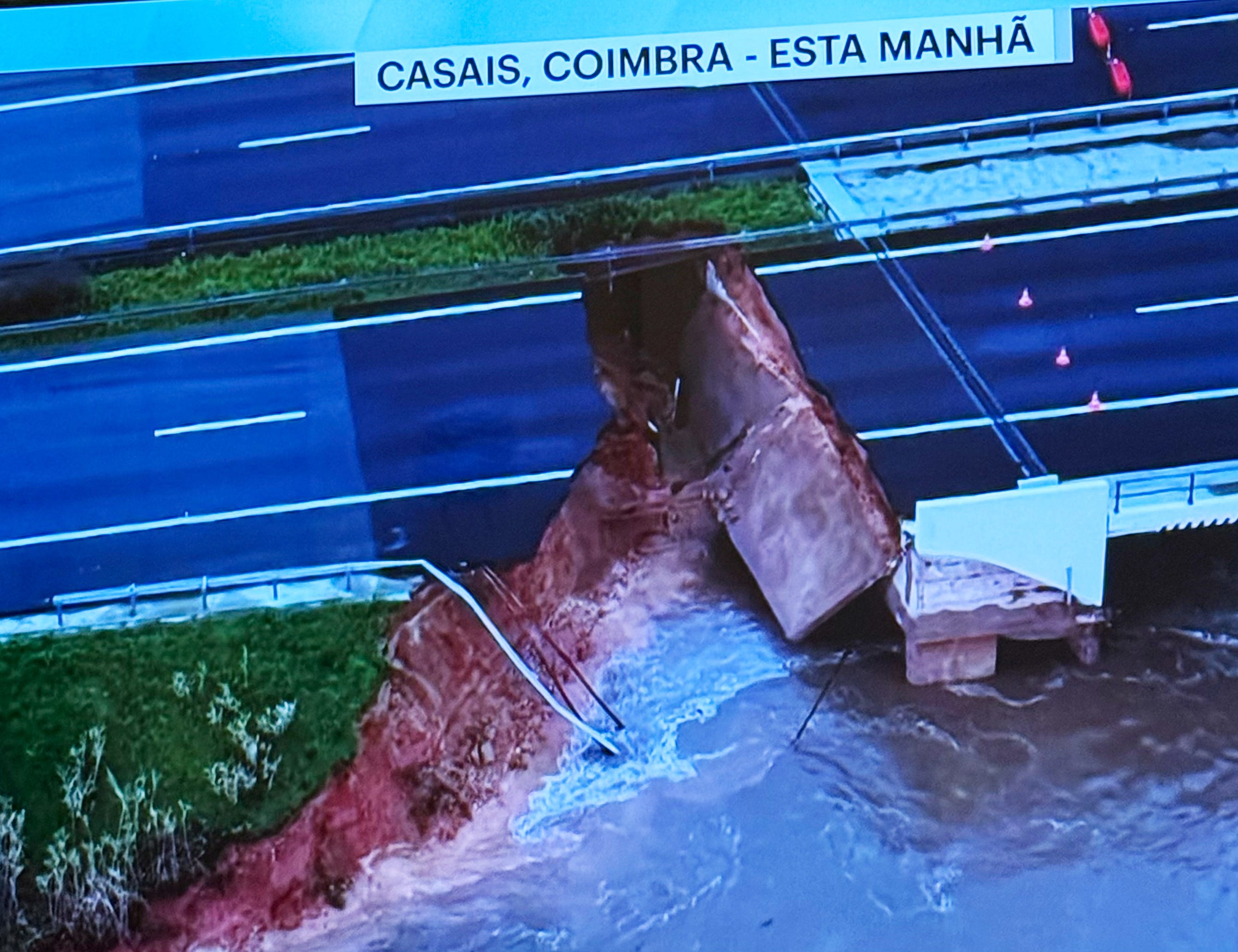
The A1, the principal motorway in the country, between Lisboa and Porto, has a 3 metre gap in it at one end of a bridge crossing the Mondego at Coimbra because of the flooding… and because, as one can see from the footage, it looks like a sand sandwich, with tarmac on top and a laje/slab of concrete beneath… not even a metre thick, laid over what used to be earth, but is now river, and not a rod of steel in sight.
This is a part of motorway on a river bank. This is the national motorway, the busiest motorway in the country, hundreds of thousands of vehicles passing over it every day but “oops, a dyke broke, and the water made that bit wet and it’s not supposed to be wet. hey ho, we’ll just have to send everyone through Coimbra city centre now!” They’re currently mending it while the flood continues.
Ah, but things do happen, don’t they? They’re bound to, occasionally.
In 2001, when the bridge at Entre-os-Rios collapsed one night, killing 60 people, the first “Portugal is a modern country” scales began to fall from my eyes. I started to wonder if life was cheap in Portugal, too. A hundred and something years old bridge just left to its own devices, left to collapse in weather similar to what we’re going through at the moment.
In 2018, five people died when a road between two quarries collapsed. If you go and find photos of the Borba quarry disaster you’ll be horrified that that road was ever allowed to exist. Nobody sane, or interested, would have ever allowed a quarry to be dug up to one side of a road, let alone one on each side, and yet, it was allowed to happen and ignored.
Ah, but things do happen, don’t they?
Over the years, I’ve seen enough cutting corners, desenrascanços, “it’ll do”, and blind eyes cast on buildings for more scales to fall. Buildings built in the last 50 years, even the luxury ones, are a bloody disgrace. God or somebody preserve us in cities when the next big earthquake happens because, no, those buildings won’t be standing.
The Glória disaster, last year, killed 16 people because of negligence, and I think they’re all still tossing around that hot potato to avoid apologising.
Ah, but things do happen…
A cyclone hit the country last week, one of the alphabet storms, Leiria district taking the worst hit. Roofs gone, houses and barracas destroyed, electricity pylons on the ground, and shopkeepers from the city to the sea not knowing how they can restart their destroyed businesses because, after the last storms, insurance premiums were just too high to pay.
And a road at Arruda dos Vinhos just slid off a hill, because it was just a ribbon of tarmac on a base of sand. Google the pictures.
Prédios (blocks of flats) in Caparica built at the bottom of the cliff evacuated because the cliff started to collapse. It’s not because the buildings were built in more innocent, more ignorant times, before gravity was a thing. They were built in the last 40 years.
Ah, but…
Disasters have always happened em grande, in Portugal. Storms, floods, fires and earthquakes are all things Portugal has suffered many times, on the regular, so it should be built for that already, it should have been being built for that for the last few centuries. Yet still everything just feels held together with brown paper and a bit of string. Poverty is not a good enough excuse.
Luckily, the people of Portugal are generally stoic and tough, especially those who live outside the cities (I think cities are bad for people). They have to be tough. Bad shit happens in the countryside all the time which doesn’t make the news, apart from the tabloids, sometimes. The bad shit happens, and people are resilient and tough and get through it, with a little bit of “ai, ai, ai!” and a lot of just getting on with it. They have no choice. But the same stoicism keeps them putting up with the corrupt and negligent and careless, leaving bridges unchecked, roads built on sand, buildings built beneath sand cliffs.
While the catastrophe is still ongoing, while the first responders and the volunteers are out, tirelessly helping as far as they can, the politicians are out politicking, the pundits are punditting, and the corrupt are bound to be corrupting behind the scenes, all of which is of the least possible use to anyone whose house is flooded from above from having no roof, or from below by being near rising water.
On the TV news, politicians are at the crisis points, standing in front of the affected place to be interviewed, surrounded, as ever by their gormless nodding posses.
At the end of the news, come the damned pundits and deputados (MPs), 1 from the left, 1 from the middle and 1 from the right, please Carol/Rachel, all trying to say it’s each other’s parties fault, not a single good, positive idea from the lot of them.
And in between, are the experts. Whether or not this is about climate change is irrelevant in this moment but there are, of course, people all over the telly finger wagging about it. What earthly use is finger wagging right now?
Governments have been told and told and told about how this country could be made more physically resilient, where to build, how to build, systems that need to improve but they care only about money, shallow, unsustainable money, at that (see Lisboa/tourism) and their short term goals in order to stay elected. They show this time and time again, all governments of all stripes.
Nothing could have stopped this nasty little gang of storms barrelling into Portugal, but there could have been better actual infrastructure that crumbled less, fewer towns built in flood plains over the decades, better building regulations that make it simpler and easier to build WELL, better warnings, and right now there could have been a government and parliament coming together for a change, instead of scoring political points against each other. It is pathetic. They could be actually finding ways to help the country and the people, sucking up their stupid egos and being better. Luckily, the people of Portugal are better than they are.
But we have great wifi, don’t we?
Every time I see a horrific disaster on the news, one that could have been prevented or avoided, I think to myself “oh, there’s somewhere where life is cheap. Noted, for future reference.”
Donate to Cruz Vermelha Portuguesa, the Portuguese Red Cross
I understand the anger. Entre os Rios and Borba were not acts of God and they exposed real failures in oversight. Portugal has had moments of short termism and uneven enforcement and that deserves reflection.
I am just more cautious about moving from infrastructure vulnerability to a wider moral conclusion. When floodwater undermines a riverbank after a dyke breach the cross section can look alarming, but hydraulic scour can remove supporting soil beneath even well engineered structures. That points to maintenance culture and resilience planning rather than necessarily to disregard.
Other Western democracies have faced painful reminders of their own blind spots. Grenfell was not a natural disaster and the UK’s RAAC crisis did not appear from nowhere. Those were serious systemic failures in wealthy states.
Portugal has governance weaknesses, certainly. I am not convinced the picture is one of indifference so much as of systems struggling to keep pace with risk.
Lucy, what an amazing article. Thank you so much for writing this. We really are the country of desenrascanço and it shows: when it crumbled down and when we put it back up again. People feel abandoned and they are right to feel that way. You put into one text what I tried to convey in multiple. Thank you!